

Two ways to leverage SOL exposure in Solana. In a good market, you can make more money. The other one won’t blow you up.
Please note: This is an editorial. I have built positions in both strategies, run the numbers against the live protocol dashboard, and verified APY at the time of writing. Yields are constantly moving, so check before deploying. Some links in this article are referral links. If you sign up through them I may receive a small commission at no extra cost to you. None of this is investment advice.
For most of last year, my answer to “how to leverage SOL exposure” was to repeat jitoSOL on Kamino. It worked. The rate of return was good. I told my friends about it.
Drift then lost $285 million on April 1.
The drift was not a smart contract bug. It was a months-long social engineering attack on the protocol’s security board, fake collateral tokens, and 12 minutes of irreversible withdrawals. Approximately a dozen Solana protocols suffered downstream exposures. The hack didn’t directly affect Kamino, but it did make me think harder about what I was staying away from. When you iterate on a lending protocol, you are betting that that protocol’s management keys, oracle infrastructure, and governance hygiene will remain clean. It’s not just smart contracts.
So I did something I should have done sooner. I compared the numbers for jitoSOL looping and xSOL’s no-liquidation leveraged token. Hylo. Both provide amplified SOL exposure. They get there completely differently.
Here’s the math.
How jitoSOL looping works
Deposit jitoSOL to Kamino, borrow SOL against it, exchange that SOL for more jitoSOL, deposit, borrow again, repeat. Kamino’s Multiply vault automates loops in a single transaction. You choose your leverage target and the protocol takes care of the rest through flash lending.
The return comes from the spread between the two numbers.
- JitoSOL Staking APY: ~7.68 ~ 8.25% (Staking + MEV Reward)
- Borrow APY on SOL Camino: Current conditions ~6.16%, depending on utilization
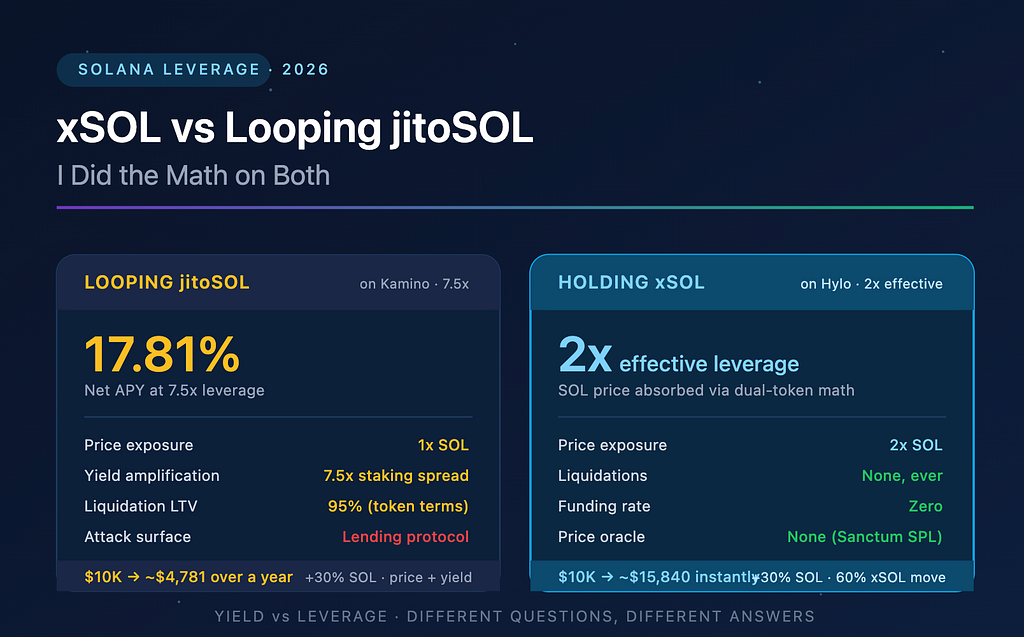
Multiply that spread by your leverage. Leveraging the JitoSOL/SOL Multiply vault 5x has historically yielded approximately 14.49% net APY. At the new 7.5x limit, this goes up to about 17.81%. eMode allows you to increase your LTV to 90%, theoretically looping up to 10x and earning close to 27% under optimal conditions.
The catch is in three positions.
Liquidation risk has decreased, but not disappeared. Kamino’s new LST oracle infrastructure prevents jitoSOL depegs from triggering liquidations. It’s worth quoting Kamino directly. SOL Multiply positions have never been liquidated with 2x or 5x leverage on Kamino. The remaining theoretical risk is a continued surge in SOL borrowing rates above LST yields, which Kamino’s analysis shows would take more than 23 days at 100% utilization to clear. A 95% liquidation LTV provides meaningful headroom.
You inherit Kamino’s operational security. Same risk rating as drift. Different protocols, different teams, clean records so far, but the structural form is the same. Compromised administrative keys, malicious governance, Oracle abuse. Looping wraps your position within the lending protocol and forwards the entire attack surface of that protocol.
The rate of return depends on the leverage ratio. When SOL borrowing rates spike, spreads compress. In a quiet market, you could earn 17%. If everyone tries to borrow SOL, its value can fall quickly and reverse briefly. Each Multiply trade also routes swaps through Jupiter, so larger positions absorb more accumulated slippage on entry and exit.
How xSOL works
xSOL is Hylo’s leveraged SOL token. This mechanism is structurally different from loops in the way it takes time to wrap your head around.
Hylo operates a dual token system. hyUSD is a stablecoin based on the Solana liquid staking token. xSOL is the leveraged side of the same collateral pool. The calculation for both is one equation. Total LST collateral value is equal to hyUSD market cap plus xSOL market cap. As SOL rises, the value of the LST pool increases, hyUSD remains at $1, and all upside flows to xSOL. If SOL goes down, the opposite happens and xSOL absorbs the loss.
Effective leverage is excluded from the equation where collateral TVL is divided by xSOL market capitalization. Today it is about twice that. Not fixed. Go with protocol activities. The more hyUSD issued compared to xSOL, the higher the leverage to xSOL. As xSOL is minted, leverage decreases. A protocol’s risk management limits how high the protocol can drift.
Important features:
- There is absolutely no liquidation. SOL drops by 30% and xSOL drops by more, but there is no forced shutdown. You endure.
- There is no funding interest rate and no lending interest rate. When CR exceeds 150%, issuance and redemption fees are minimal (approximately 1% each according to third-party reports). Fees are adjusted dynamically when stability mode is enabled.
- There is no LST price oracle. Hylo uses Sanctum’s stake pool data to price each LST and derive the true value of SOL staked in the SPL pool program. This is not a market price feed. The oracle manipulation surface used by Drift to inflate fake CVT collateral is not present here as the pricing logic requires actual staked SOL.
- Limited collateral categories. Governance can add new LSTs to the registry, but pools only accept assets that integrate with Sanctum’s stake pool program. A compromised governance vote cannot whitelist a token the way a compromised governance key in Drift can whitelist CVT. This is because there is no mathematically readable basic stake SOL.
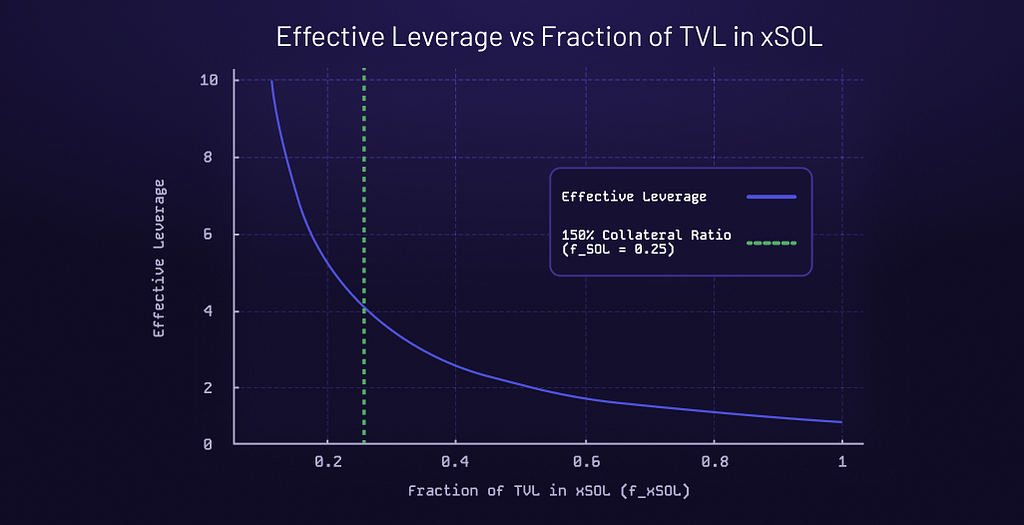
Hylo has two built-in stability modes: Below 150% CR, fees are adjusted to encourage behavior that strengthens the system. Below 130%, the stability pool is activated and converts staked hyUSD to xSOL to defend the peg. This occurred in the first quarter of 2026 and the mechanism worked as designed.
The structural difference from looping is that nothing is borrowed. You are holding a token whose price is falling in a closed-loop equation between a stablecoin and a leveraged token. Non-credit based mechanical leverage.
Calculation for $10,000 position
Let’s look at both in concrete numbers. For example, SOL is $150.
jitoSOL repeat at 7.5x on Kamino
Deposit $10K of jitoSOL. The vault controls jitoSOL exposure of approximately $75K, backed by $65K of SOL debt, looping to a 7.5x position.
- Flat Market: ~17.81% net APY returns approximately $1,781 per year.
- SOL increased by 30%: Your USD assets increase by approximately 30% (relative to the price), and you continue to earn a spread of ~17.81%. Approximate price of $3,000 + return of $1,781 = ~$4,781 over one year. Looping amplifies returns, not price exposure. Your USD assets move 1x to SOL.
- SOL down 30%: Your USD assets fall by about 30% along with SOL. Since both collateral and debt are priced at SOL and fall together, the LTV on the token side does not change. The liquidation path is a sustained borrowing rate reversal, not price action. Kamino’s analysis shows that 95% liquidation LTV is reached after 23 days or more with 100% utilization.
Hold xSOL on Hylo with 2x effective leverage
Purchase $10,000 of xSOL. You start with an effective position of $9,900 after a mint fee of approximately 1%, controlling exposure equivalent to approximately $19,800 SOL.
- Flat Market: You don’t get anything extra. xSOL is not an output.
- SOL increased by 30%: Your position increases from $9,900 to approximately $15,840, an increase of approximately 60%.
- SOL down 30%: Your position falls about 60% to about $3,960. It’s painful, but you’re still doing the deal. Please wait until SOL is restored. No clearing.
- round trip cost: Approximately 2% under normal conditions, higher when exiting from stable mode.
Calculation: Looping provides 1x SOL price exposure and amplified returns (~17.81% net APY at 7.5x). xSOL provides 2x SOL price exposure with no returns. At a 30% one-year SOL move, looping returns ~48%. xSOL returns ~60%. The looping yield in the flat market is ~17.81%. xSOL returns 0%.
When xSOL actually beats looping
All three are more important than ever after the Drift hack.
Attack surface. Looping requires that the lending protocol’s contracts, price oracles, management keys, governance, and operational hygiene all remain clean. xSOL requires Hylo’s contracts, Sanctum’s stake pool integration, and the underlying LST to be kept clean. Drift’s specific attack vector (whitelisting fake tokens via compromised admin keys) does not apply to Hylo. Pricing of the protocol requires actual staked SOL under the accepted collateral. Smart contract risks are real for both parties. OtterSec audited Hylo.
Cost of volatile markets. The looping yield is the spread between the LST APY and the SOL borrowing rate. In a quiet market, it’s fat. In volatile markets, it compresses or reverses. xSOL has no funding or borrowing rates. Fees remain manageable under normal conditions and are only adjusted when the system needs to defend its peg.
Mental load. It sounds soft, but it’s important. Looping allows you to check LTV, observe utilization, and monitor whether leveraged APY exceeds LST yield. xSOL allows you to buy, hold, and sell when you reach your goal. There are no positions to manage, so there is no position management.
When Looping Actually Beats xSOL
There are two places, really.
Profit from good markets. When SOL is cut sideways for one year, jitoSOL roofing is printed. You can earn spreads regardless of price movements. xSOL does not pay for retention. xSOL is a directional bet. If you’re wrong about the SOL rise, you won’t get returns in consolation.
Risk of volatility collapse. xSOL is path dependent. In choppy sideways markets, dynamic rebalancing can erode value even if SOL ends where it began. A typical leveraged token collapse. Hylo openly admits this. Looping performs better when the SOL is plowed sideways with high volatility.
So which one do you actually use?
Both. Different locations, different capital retail.
For sleeves looking for stable returns in both rising and falling markets, jitoSOL looping Kamino with moderate leverage (3x-5x) still works. The returns are real, liquidation risk is substantially lower than it used to be, and Kamino’s track record is clean.
For sleeves that want directional SOL exposure with structural certainty without clearing, xSOL is the cleaner tool. 2x effective leverage makes sense, no funding percentage means I don’t pay out, and no admin key whitelisting risk has made it more attractive since Drift.
If I had to choose one for a friend who has never used either, I would send them to xSOL first. Not because the output is better (it usually isn’t), but because the cognitive load is lower. Buy, hold, sell. There is no LTV monitoring, no eMode, no borrowing rate viewing. All you need is price exposure where the bottom of the action is known.
You can try Hylo through the recommended link below. If you do that, I get a small share of XP. You get yourself a 5% boost.
TL;DR
- jitoSOL iteration on Kamino: ~17.81% net APY at 7.5x, up to ~27% at 10x using eMode. The yield comes from the LST/borrowed spread. Kamino’s own statement: SOL Multiply positions have never been liquidated at 2x or 5x. You still inherit the full attack surface of the lending protocol.
- Have xSOL at Hylo: ~2x effective leverage. No clearing, no funding rates, no LST market price oracles. Fees are minimal in healthy markets and dynamic in stressful situations. Reduced volatility actually occurs in choppy markets.
- best roofing: Provides stable yield through cutting and grinding.
- Best xSOL: Directional SOL betting without margin call risk.
Choose the question you actually want to answer. “Make money on my SOL” and “Buy SOL with leverage” are different questions and have different answers.
source
- Hylo: hyUSD and xSOL dynamics
- Hylo: Take advantage of xSOL
- Hylo: Risk Management and Stability Mode
- Hylo: Earn money with hyUSD
- Camino: Multiplication Mechanics
- Drift Protocol Postmortem Coverage (Chainalytic)
- Hylo 1st quarter 2026 operations report
If this has saved you some research, hit Medium to help you find other Solana DeFi traders. Is there another take? Please leave a comment. I have read all the answers.
Editorial comparison, not financial advice. APY and protocol parameters based on each protocol’s documentation and dashboard at the time of writing. Check before deploying capital. Leveraged products involve real risks, including total loss. Some of the links above are referral links. If you sign up through them, I may receive a small commission at no additional cost to you. This does not affect the view above.
xSOL vs. Looping jitoSOL: I Did the Math on Both was originally published on Coinmonks on Medium, where people are continuing the conversation by highlighting and responding to this story.