

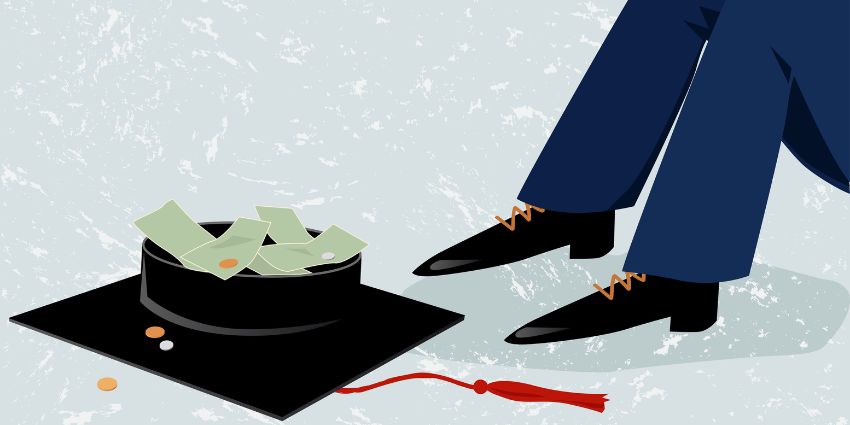
When real estate agent Gloria Caulfield told University of Central Florida graduates that “the rise of artificial intelligence is the next industrial revolution,” the crowd booed rather than applauded.
It was the first of a series of similar scenes on US campuses over the past month, including former Google CEO Eric Schmidt being booed mid-speech.
The reasons for the dissatisfaction are not surprising. Because AI is taking away jobs.
The U.S. tech sector has announced cuts of more than 123,000 jobs in 2026 alone. This is a 66% increase compared to the same period last year, and AI is now the most cited reason by employers.
Entry-level positions filled by graduates have been hit hardest.
However, some top technology executives still appear perplexed by the cold response to AI, raising questions about the disconnect between the world of technology and the real world.
Convenient history class
this week Brad Smith, Vice Chairman and President, Microsoft We published a detailed thought leadership piece to address the anxieties faced by our graduates.
Smith begins with the story of the French painter Paul Delaroche, who declared, “From today, painting is dead!” The moment I saw an early photograph from 1838. Smith reminds us that the camera did not kill painting, but rather sparked Impressionism, Post-Impressionism, Cubism, and entirely new art movements.
That’s a fair point. But portrait painters lost their jobs when photography arrived. The transition wasn’t painful or immediate. And, crucially, the period of time (decades) over which art is reinvented is cold comfort to anyone whose income disappears next quarter.
noteworthy numbers
In 2025 alone, Microsoft shed approximately 15,000 jobs through multiple rounds of layoffs.
In April 2026, the company proposed voluntary layoffs for about 7% of its workforce, even as it continued to pour billions of dollars into its AI infrastructure.
A 2026 Motion Recruitment study found that hiring for entry-level and general IT roles is already slowing due to AI adoption. These are exactly the positions that historically graduates would have entered.
The unemployment rate for recent U.S. college graduates will reach 5.8% in 2025, in part due to companies replacing entry-level functions with AI tools.
The pain of transition, Smith acknowledges, is real and present and disproportionately affects the audiences he addresses.
“Task Bundle” Framework
Smith supports the book’s framework. Openness to Work: How to Stay Ahead of the AI EraCo-authored by LinkedIn CEO Ryan Roslansky and Aneesh Raman.
This requires employees to stop thinking of their jobs as positions and start thinking of them as “bundles of tasks” categorized into three buckets: things AI can do alone, things AI can do alone, and things humans need to do alone.
For many workers, this can be a really useful way to look at AI.
But this places the burden of adaptation entirely on the individual and does not fully engage with the structural questions of whether the new roles created by AI will be realized at the speed, scale and wage levels needed to absorb those they replace.
conclusion
Graduates booing on campus were sending a message to the industry that was ultimately responsible for the chaos they were entering.
Smith took that message more seriously than most of his colleagues.
However, participation does not equal responsibility. In all sincerity, this work ultimately imposes adaptive burdens on individual workers. That means learning AI fluency, rethinking bundles of tasks, and developing soft skills.
What is lacking here is any suggestion that companies that deploy AI at scale and reduce their workforces to fund it must bear corresponding responsibility for what happens next.
Smith calls it a shared challenge. So far, sharing appears to be one-sided.