

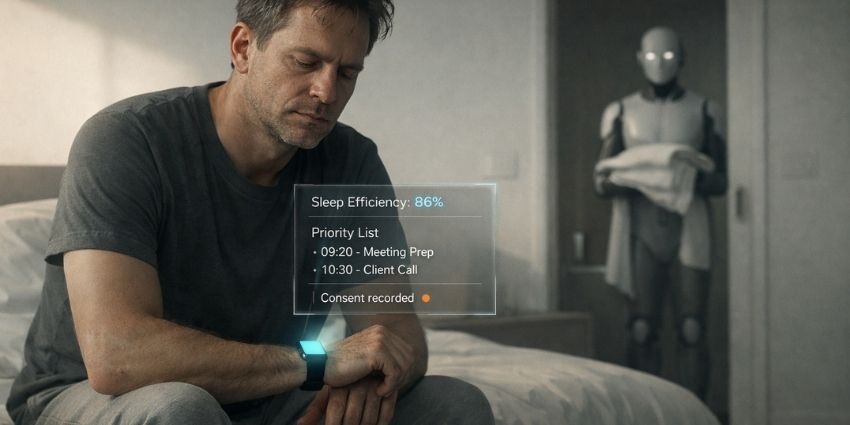
I wake up before I’m ready.
Not because I chose to. This is because the vibration of your wrist lets you know if you got enough sleep. It’s no longer an alarm. Here’s the verdict. A soft, steady pulse that doesn’t stop until my hands move, until my eyes open, until my system does what I want it to do.
It’s no longer an alarm. Here’s the verdict.
“Good morning, Rob.” My alarm person speaks in a friendly and calm manner, as if he were standing next to my bed.
Ceiling light does not turn on. them fade inGently, as if you were being introduced to the day rather than being thrown into it. The air has also become warmer. It’s a few degrees more comfortable than it is now.
A translucent panel appears above the bedside table. It’s not on the screen. In the air. A neat floating list that follows my gaze as if it were glued to my interest.
sleep: 6 hours 41 minutes (efficiency: 86%)
recovery: ordinary
Mood prediction: stable
Friction risk: low
I look at the last one.
Friction risk.
This is a number that indicates how likely it is that I will be in trouble.
Friction risk. This is a number that indicates how likely it is that I will be in trouble.
“Your first priority is scheduled for 09:20.” The agent continued. “I’ve already adjusted the start time to 9 minutes. Another assistant requested it. No conflicts detected.”
I sit down and feel that familiar pressure behind my eyes. It’s that half-second moment where you try to remember what day it is, who you are, and what you promised to do.
“Would you like me to boil a kettle for you?” It asks:
I don’t answer. I breathe, blink, hesitate. That’s enough.
“The kettle is on. Standard mug. Oat milk. Coffee strength reduced by 12% depending on sleep efficiency.”
I hear a soft click of something turning on somewhere downstairs, followed by the quiet sound of water pouring. The house now behaves as if it has a nervous system. It felt like it had been awake for hours, waiting for me to catch up.
I swung my legs on the bed. The floor is warm under your feet. That’s always the case. It’s such a small detail, but it’s the kind of detail that makes you not notice it at all.
A second panel will appear in the air.
Breakfast options (optimized):
- Eggs (expiration date: 2 days)
- Greek yogurt (expiration date 4 days)
- Strawberries (eat today)
- Granola (opened 12 days ago, poor quality)
I’m not saying what I’m talking about. ~can do eat.
It tells the system what it prefers. Don’t waste it.
I go to the bathroom, but the shower starts before my hand even touches the dial. The steam rises in a controlled seat and the temperature is locked at the exact setting you’ll always choose anyway. The whole routine feels like the house is trying to be helpful, but in a way that leaves no room for argument.
While I was washing my hair, the counselor spoke again.
“I’ve queued up your morning news digest for breakfast. We’ve got breaking news updates on priority topics from two of your favorite outlets. You were mentioned in one post.”
“To whom?” I asked and then realized how automatically I started speaking out loud to a system that didn’t look like a person in the room.
“LinkedIn. This is a contact I keep in touch with often. I have positive feelings about it.”
I smile for a moment before remembering how strange it is that my micro-dopamine hits also contain metadata.
I get out of the shower.
And the day becomes physical.
A humanoid robot is standing holding a towel.
It’s not dramatic. It’s not threatening. that… professional. Smooth faceplate. soft eyes. Neutral posture. Like a hotel concierge who is trained to appear exactly when needed and disappear when not needed.
It serves to keep the towel open, as if welcoming a child out of the swimming pool.
“Good morning,” I say, and the voice is the same as my agent’s, but now I have a body. shape. existence.
The agent is no longer idle. It stands before me.
I paused for a moment, dripping water onto the mat, suddenly aware of my own awkwardness—my shame as a human being. It’s the kind of thing that doesn’t fit neatly into a system designed to eliminate uncertainty.
The robot adjusts its posture slightly to calculate the angle of the towel so I don’t fumble. It was draped over my shoulder with a precision that felt intimate without feeling affectionate.
“We have your favorite Monday workwear,” it says.
Wardrobe panels glow softly. Another holographic overlay with a neat list and confidence bar flashes next to it, as if my clothes are now a prediction.
- Navy overshirt (92% match)
- White t-shirt (89% match)
- Black pants (87% match)
- Trainer (81% match, weather adjustments applied)
I’m not asking you what you want to wear.
It tells me what to choose, and it’s annoyingly accurate.
The robot selects and places the overshirt. There are moments when I think I should pick something else out of pure stubbornness to prove that I can do it.
But I’m not like that.
It doesn’t force you. It makes resistance feel unnecessary.
As I brush my teeth, the robot lifts its hand and a faint, cool line of light sweeps across my face and neck.
The phrase “Health checkup in progress” is casually written. “Hydration is low. Mild inflammation markers are elevated. No emergency flags.”
There is no emergency flag.
I rinse my mouth and look at myself. For a moment, I imagine a different version of this morning. One is a state in which I am still in control, the other is a state in which my body is not quietly monitored, like a machine in need of maintenance.
When I put on an overshirt, the robot adjusts the collar. Small tugs, gentle movements. It’s the subtle corrections you can only get from someone who loves you, or someone who is tasked with perfecting you.
“The children’s wake-up routine has begun,” it reads.
“I didn’t ask—” I begin.
“Usually on Mondays I ask to wake up at 07:22. Today I have to wake up at 07:18. It’s a slow start.”
It asks: But only after it’s already been done.
He steps back slightly as if to give me space, but the space feels staged.
“The car cabin is preheated to 21 degrees,” he adds. “Route confirmed. Morning traffic coordination.”
Traffic is coordinated.
I let out a short laugh because that was ridiculous.
And because it’s true.
Downstairs, the kitchen is already operational.
The kettle hums softly. My mug is always there. My coffee is exactly how I make it.
News does not appear on the screen. The screen looks old now. Headlines hang in the air above the counter like surfaced thoughts.
The curated breakfast digest scrolls smoothly, letting me know how long I’ll spend looking at each item before deciding I’ve “consumed” it.
- Regulators expand vicarious liability laws.
- Major retailer gets sued over autonomous price spikes
- Workplace: Human-In-The-Loop roles shrink again
On the right a second column is formed.
Today’s offer.
This is the hotel in the place I once mentioned. A jacket similar to the one I saw in the shop window last year. A weekend plan made from the gaps in the calendar like a magician pulling a rabbit out of empty space.
“We’ve shortlisted three weekend options,” my agent says. “It is based on weather stability, cost effectiveness and expected energy levels.”
Show me the options anyway because you know curiosity is easier than consent.
Option 1: Country walk and pub lunch.
Option 2: City Exhibition.
Option 3: A short overnight break, discounts… Because I know the numbers that will make you hesitate long enough to be tempted.
“Would you like to invite someone?” It asks:
Before I answer, I would like to add this:
“I’ve already checked availability with my agent. Two are free. If you delegate a family appointment, one is free.”
Because it’s not just about scheduling. It’s about negotiating life.
I raise my hand and snap two fingers towards the country option. Your selection will lock with a soft chime sound.
It says “Reserved.” “This is a final confirmation awaiting consent from the parties.”
Final agreement.
As if that makes it any better.
I take a sip of coffee. It’s perfect.
And that’s the problem.
Because now even the smallest pleasures arrive pre-selected, pre-approved, and pre-optimized. It’s as if someone who knows better than me is catering to my tastes.
When it’s time to leave, I don’t pack my coat.
Robots are like that.
It puts it in my hand at the very moment it touches my body. The timing is so perfect it feels like you practiced it. And for the first time that morning, the following thought occurred to me:
How many times have you simulated me?
The front door opens by itself. The outside air touches my face. Cold, sharp and honest.
The car is waiting on the curb, like it’s been there for minutes, like it knew I’d come out at this exact time.
The door opens.
It’s warm inside. 21 degrees as promised. The seat moves underneath me to adjust to my posture. The steering wheel moves back slightly, as if embarrassed that it still exists.
“Destination: Office,” the car says.
I don’t say where I’m going. You don’t need it. It knows the patterns, the routines, the recurring aspects of me.
The car pulls off quietly and joins the flow of vehicles that is both eerie and moving.
There are no braking waves. Suddenly they don’t merge. Don’t honk your horn.
Just go with the flow.
We glide across the intersection without stopping. Everyone was perfectly spaced. Everyone at the same speed. Just as roads are no longer places for humans, they are infrastructure for predictability.
Solving congestion doesn’t mean traffic has disappeared. Traffic disappeared because we gave up spontaneity.
I see the city moving by smoothly, quietly and efficiently.
And I gently realized something like the truth you don’t want to admit.
The world will not become more intelligent in 2030.
It has become more certain.
And certainty is very much like being managed.
(Next chapter coming soon.. Bookmark this page)
New series: One day in 2030
This story lays the groundwork for a new series I’m launching at UC Today. One day in 2030 — A first-person guide to what work really feels like when AI agents, automation, and ambient computing fade into the background and you start making decisions before you’ve even had your coffee.
New chapter every week — And the next action moves inside the office. It’s an identity check, a co-worker being present by an agent, and a meeting that starts before anyone speaks.
Follow me on LinkedIn for early previews and upcoming content.
Related: The Future of Work
This series comes with extensive coverage from UC Today. future of work—especially the transition to ambient AI;
Invisible hardware, spatial workplace. If you haven’t read it yet, it will be a useful companion.
Is this the future of work? Ambient AI, invisible hardware, and space offices