

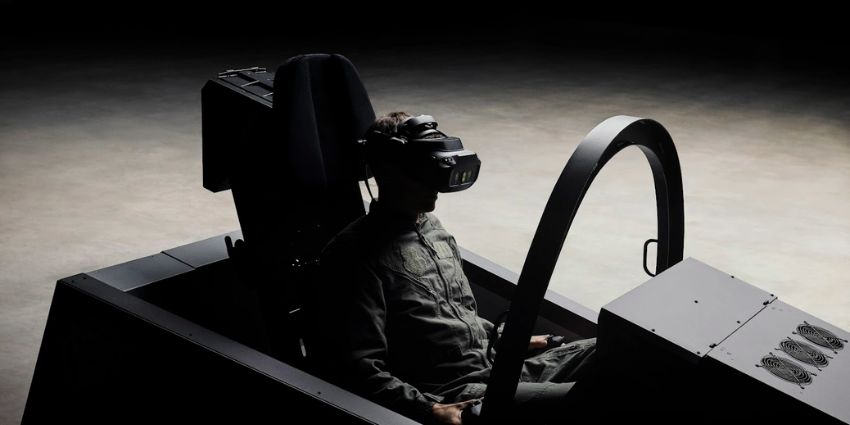
At a training facility in Finland, pilots sit inside a life-size mockup of the cockpit, wearing an XR headset that overlays a fully simulated environment beyond the physical frame.
The switches, dials, and controls are real, but everything outside the cockpit window—from the weather system to the terrain to the rest of the aircraft—is virtual.
The result is a hybrid training environment that blends physical hardware and digital simulations, allowing trainees to repeatedly and safely practice complex scenarios.
For Varjo, a Finnish company that has created headsets for use in these environments, this is where the XR finds its most immediate and practical use.
“Enterprise XR adoption is piecemeal, but education, especially in the military, is seeing real traction,” he says. Patrick Wyatt, Director of Product at Varjo.
Shifting from consumer hype to industrial use cases
Extended reality, which includes virtual reality and mixed reality systems, has long been associated with consumer gaming and enterprise collaboration experiments.
However, over the past few years, the training has been most consistently adopted by many industries, particularly aviation, defense, and emergency response.
These changes reflect broader industry patterns.
same company microsofthas focused on defense and industrial applications, including battlefield awareness systems and maintenance training, through its HoloLens program.
Meanwhile, headset manufacturers such as HTC We targeted enterprise simulation environments, including manufacturing training, aerospace, and aviation simulation use cases within our broader XR training system.
However, in defense simulations, historically dominated by large physical simulator domes costing tens of millions of dollars, XR is increasingly becoming a cheaper alternative.
Traditional full flight simulators used for aviation training cost upwards of $10 to $20 million per unit, require dedicated facilities, and are limited in how quickly scenarios can be modified.
XR systems aim to reduce both cost and complexity by shifting the majority of simulations to software.
Explore Varjo’s approach to mixed reality education
Varjo’s system is the high-end of the XR market and is designed specifically for industrial and defense applications, not consumer use.
In practice, headsets are used to merge real-world physical environments, such as cockpits, with simulated external visual elements that are rendered in real time. The goal is not just immersion, but fidelity. The idea is to ensure that what the pilot sees closely matches what he or she experiences in real life.
“Our most advanced customers are creating a complex mix of physical and virtual environments,” explains Wyatt.
“There can be many different systems that render different parts of a scene, but our headset integrates these elements and tracks the user’s hands.”
This mix of physical and virtual inputs allows training programs to simulate everything from basic flight procedures to emergency scenarios that are too dangerous or expensive to replicate in the real world.
Defense as a primary growth market
The company’s technology is primarily deployed in the defense sector in NATO member countries. According to Wyatt, this includes programs within the U.S. Army and U.S. Air Force, along with European defense agencies.
One such example is the U.S. Army’s Reconfigurable Virtual Collective Trainer, used for helicopter simulation training across platforms such as Black Hawk, Apache, and Chinook.
Defensive XR is not new, but its role is expanding as the military works to reduce costs, increase training frequency, and improve data capture during training.
“During a session, you can track things like eye movements and reaction times,” says Wyatt. “This allows us to obtain data that is typically unobtainable from traditional simulators.”
This reflects broader trends in defense technology, including the shift from purely physical training systems to data-rich digital environments that allow for more detailed performance analysis.
Wider defense simulation ecosystem
XR training is ultimately part of a broader ecosystem that includes simulation integrators, defense contractors, and government programs.
large defense companies such as lockheed martin and boeing We have been developing simulation environments for pilot training and mission rehearsals for a long time. Traditionally, these systems have relied on large-scale physical simulators or desktop-based virtual environments.
What is changing is the increasing role of lightweight headset-based systems that can be deployed more flexibly without fixed infrastructure.
This is especially relevant in distributed training environments where staff may need to be trained in multiple locations or outside of a traditional simulation center.
Measure the impact of XR training
One of the most frequently cited claims in the field of XR training is that immersive simulations can reduce training times and improve performance. However, the strength of the evidence varies greatly depending on the program.
Data shared by Varjo from the U.S. Air Force’s Defense Innovation Agency program suggests measurable improvements in pilot training outcomes.
In one experiment, trainees achieved solo flight 50% faster than their peers using a non-immersive approach. The same program reported improved performance across 33 out of 40 operations, with potential annual cost savings of approximately $350 million.
While these figures are from a specific test environment and may not be applicable across the board, the evolving nature of the defense industry (combined with expected increases in spending by NATO countries in the future) may indicate a growing interest in XR within the military domain.
Security Constraint Shape Design
However, unlike consumer VR systems, XR in defense environments must meet stringent security requirements that impact both hardware and software design.
Varjo says its system is designed to operate without external connectivity, cloud services or user logins, allowing it to be deployed in secure or air-gapped environments where data cannot leave controlled systems.
“Security is very important in these situations,” says Wyatt. “This includes everything from how software is certified to how hardware is manufactured.”
This also influenced manufacturing decisions.
The company produces a line of security headsets assembled in Finland and designed to meet procurement requirements for NATO-aligned defense programs.
However, XR training systems rarely have standalone deployments.
Instead, they are integrated into complex simulation environments that involve multiple vendors, software layers, and legacy infrastructure.
This creates integration complexity, one of the biggest barriers to widespread adoption.
To solve this problem, Varjo introduced a bundled system that combines a headset, pre-configured computing hardware, and software into a single package designed to reduce setup friction for system integrators.
“The idea is to reduce the integration burden,” says Wyatt. “Rather than assembling disparate components, integrators can deploy systems that are already configured to work together.”
Limitations of Current Adoption
Despite its strong potential, XR training is not distributed evenly across the defense sector.
Some programs are fully integrated into the operational training pipeline, while others remain in the pilot or experimental phase. This creates a fragmented adoption environment with widely varying outcomes and maturity levels.
There are also broader questions about cost, scalability and long-term effectiveness compared to established, tired and tested education systems.
As with many new technologies in defense procurement, adoption tends to be incremental rather than transformative.
Looking to the Future: Different Hardware Paths
The XR industry itself is evolving in two distinct directions.
On the one hand, consumer devices are moving toward lighter, wearable formats, such as smart glasses, targeting productivity and augmented reality applications. On the other hand, high-fidelity training systems continue to require more powerful hardware capable of rendering complex real-time environments.
Wyatt expects this gap to continue.
“Even five years from now, lightweight devices may still be able to play a role, but they will not reach the level of detail needed for these kinds of training scenarios,” he says.