
My Keynote Presentation to the 2026 Virtual Worlds Best Practices in Education (VWBPE) Conference – Ryan Schultz

NOTE ON MY GENERATIVE AI USAGE: While most of the writing of this blogpost is me, Ryan Schultz, unassisted by GenAI tools, I should note that, in the attached PowerPoint presentation, I did make extensive use of Google NotebookLM by feeding my entire blog into a notebook, and asking it questions (as described in a blogpost here). I used many of the answers I received back in creating both the slides and the speaking notes attached to the slides, in parts two and three of my presentation. That includes the quoted speaker notes below the pictures of specific slides in this blog post!
Part one of my talk, the quotes from Andy Fidel’s keynote speech at last November’s IMMERSIVE X, which inspired me to create and give my presentation last Friday, were taken from a copy of Andy’s speaking notes which she very kindly shared with me, as her TED-style virtual talk on the ENGAGE social VR platform was not posted to YouTube by her request. Thank you, Andy!
As some of you might know, a while back I was asked by my librarian colleague (and fellow Second Life aficianado) Marie Vans if I would be willing to be one of the three keynote speakers during the 2026 Virtual Worlds Best Practices in Education (VWBPE) Conference, which is held every year in the pioneering virtual world of Second Life. I said yes (of course!). I never turn down an opportunity to give a presentation in my beloved Second Life. (I was asked to speak at the 2021 Virtual Ability Mental Health Symposium, giving a presentation on the topic of this blogpost on acedia during the pandemic, and in 2024, I gave a presentation on virtual world building in Second Life, in Second Life, to a graduate class in virtual world building and design, which was team-taught by a computer science professor and an interior design professor.) So, as you can see, this was not my first rodeo. 😉

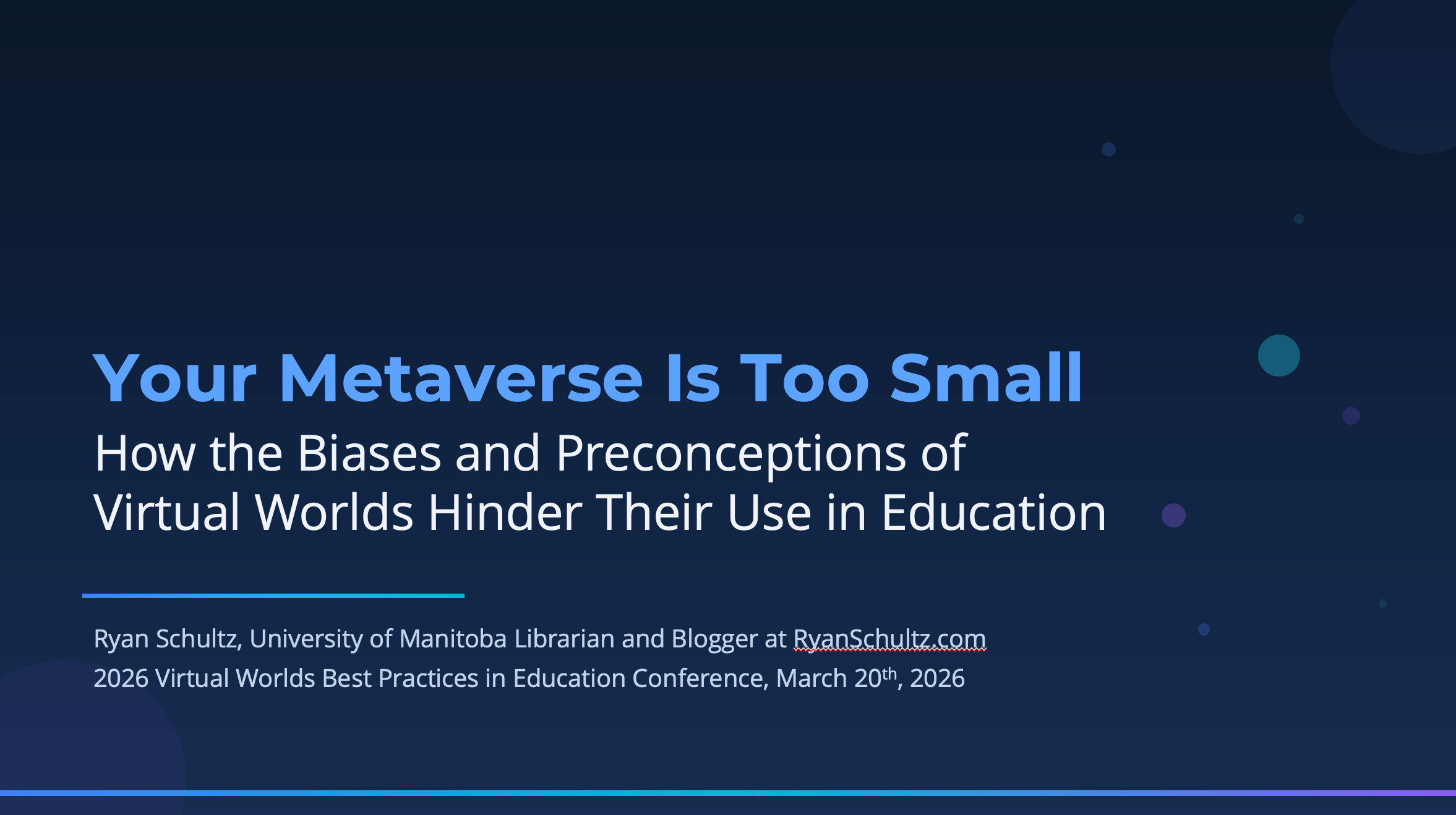
The title of my presentation, which I gave as the keynote speech of the conference on its second day, Friday, March 20th, was Your Metaverse Is Too Small: How the Biases and Preconceptions of Virtual Worlds Hinder Their Use in Education. I was inspired by a keynote address at last November’s IMMERSIVE X conference by Andy Fidel, who titled her talk, held on the ENGAGE social VR platform: The State of the Metaverse in 2026. My talk therefore consisted of three parts as follows:
- Quotes from Andy Fidel’s talk which I found inspiring and wanted to share (7 slides);
- My initial, general observations about the metaverse (4 slides); and finally
- A section titled Your Metaverse Is Too Small, where I discuss various ways our biases and preconceptions about virtual worlds and social VR/AR actually hinder their effective use in educational settings (with reference to Andy’s comments; 14 slides).
Yes, it’s a lot to cover in 45 minutes, but I did it! I’m just going to share my slides as-is, without any Creative Commons-type license this time around, since a lot of it is referring back to Andy Fidel’s ideas, which I found so inspirational in the first place. And yes, while the topics of these 14 slides in part 3 all sprang out of one particularly fevered brain dump of my ideas one evening, rather than relying on GenAI, I do freely admit that I fed my entire blog into a Google NotebookLM and asked it questions in order to create the content based on thirteen (yes, 13!) different ways that, quote: “your metaverse is too small!”

Your metaverse is too small because…
- it has too steep a learning curve for new users
- your platform has a poor fit-to-purpose
- it lacks accessibility features (e.g. speech-to-text for the Deaf/HoH community)
- it is poorly designed and/or Quality Assurance tested, and it causes VR sickness/nausea (more common among women than men)
- it is soulless/designed by committee (hello Meta Horizon Worlds and Workrooms! Proof positive that you cannot will metaverse platforms into existence by executive fiat and the spending of billions of dollars.)
- it requires a VR/AR/XR headset (I used two slides to discuss this controversial take; see below for more detail)
- it relies on cryptocurrencies, NFTs, or some other form of blockchain (do I really have to explain this at this point?)
- it has poor (or non-existent) safety and trust features and policies
- it focuses on the product rather than the community
- it has user data privacy issues/is based on surveillance capitalism (once again, hello Meta Horizon Worlds and Workrooms!)
- you fail to market it properly (or, in many cases, fail to market it at all)
- it is unfriendly to different cultures and subcultures (e.g. trans people, furries, etc.)
- (another controversial one, explained further below) it refuses adult content
Now, before all you social VR adherents rise up with torches and pitchforks and tar and feather me for even daring to say “your metaverse is too small because it requires users to have a VR/AR/XR headset,” here are the two slides, plus speaker notes:

Your metaverse is too small because it requires you to use a virtual reality headset.
It is not a surprise that many of the most popular social VR platforms (e.g. Rec Room, VRChat) also allow for non-VR users to participate. The VR headset market still has not taken off. Even the best-selling Meta Quest line of wireless virtual reality headsets (which make up an estimated 70% of the global VR headset market) has sold only approximately 30 million units around the world, and many of those devices land up collecting dust after the initial novelty of the product wears off. Apple’s Vision Pro, launched to enormous fanfare, does not publish sales figures, but industry reporters said that the company shipped approximately 390,000 units in 2024 and approximately 90,000 units in 2025. VR hardware remains bulky, heavy, and uncomfortable for extended wear. Nausea continues to affect a significant proportion of users. A VR headset isolates the wearer from their physical surroundings and from the facial expressions of the people around them—an anti-social device, in practice, even when its purpose is socialization via social VR.
The PC-tethered VR headset market—the high-end, high-fidelity segment that many early social VR platforms had built toward—proved especially stagnant. The dream of millions of consumers owning gaming-grade PCs with tethered Oculus Rift or HTC Vive headsets never materialized. Even the shift to standalone headsets like the Meta Quest series failed to generate the consumer mass-market that had been anticipated. Sansar is perhaps the most instructive case study in the danger of building a platform around assumed headset adoption. Developed by Linden Lab—the company behind Second Life—Sansar was announced in 2014 and launched in beta in 2017, timed almost precisely to coincide with what seemed like the dawning of the VR era following Facebook’s acquisition of Oculus. But the bet on tethered PCVR headsets never paid off. In March 2020, Linden Lab sold Sansar to a little-known startup called Wookey and pivoted to focus on live music events and virtual concerts, attempting to find a more sustainable niche. That hasn’t worked, either. Sansar still exists, but it is only being kept alive by volunteers at this point.

Research on technology adoption consistently shows that devices requiring behavioral change—for example, for VR, wearing something on your face, isolating yourself from physical surroundings—face much higher adoption friction than technologies that integrate into existing habits. The iPhone and Android phones succeeded partly because they fit into already-established phone-carrying behavior. VR headsets require building a new behavior from scratch.
The failure of the last metaverse hype cycle does not mean that immersive technology has no future. What failed was the specific prediction that millions of people would soon be spending significant time in virtual worlds accessed primarily through VR headsets; that this would create platform-scale opportunities comparable to social media or mobile devices.
Don’t hate me for speaking facts. No VR/AR headset (even the Meta Quest line of headsets) has taken off in the way that iPhones/Android phones and tablets and smartwatches have. In particular, the developers of those platforms who bet the farm on widespread adoption of high-end tethered PCVR headsets (hello, Sansar and High Fidelity!) lost that bet badly; Sansar is essentially moribund, and High Fidelity is now closed (although it does live on in its successor social VR platforms Vircadia and Overte, which were based on HiFi’s open-source codebase, but are also not heavily used). This failure is one of the reasons why Second Life is still going strong (or strong enough) to endure and still be profitable for Linden Lab, for over 22 years now.
And speaking of SL…

I want to make one thing very clear: in some educational applications of the metaverse (especially those intended for children and teenagers, i.e. K-12 education), a ban on adult content is absolutely necessary.
However. As my speaker notes for this last slide in my presentation state:
However, in any institution of higher learning (e.g. a university). you will find faculty, staff, and students teaching about, learning about, and doing research on topics which may include controversial or adult topics. I have argued that one of the most significant strategic errors a metaverse platform can make is the outright refusal to host adult content (or do some other sort of heavy-handed sanitization of adult content, like imposing baked-on underwear on the base male and female adult avatars).
In my blog, I’ve pointed out that for some successful virtual worlds, adult communities are not just a niche—they are the economic and social engine that keeps the lights on. I have frequently cited Second Life as the prime example of a platform that understands the value of adult content. On my blog, I’ve noted that the adult-rated regions of Second Life generate a good portion of the platform’s revenue through land tier fees and the sale of virtual goods (clothing, skins, animations). In contrast, I wrote about Sansar’s early decision to strictly moderate content and its struggle to establish a clear policy on adult material. I argued that by trying to keep the platform “brand-safe” for corporate partners, they essentially “cut off their nose to spite their face,” alienating a potential demographic of creators and consumers who were ready to spend money on higher-fidelity adult experiences. And the corporate clients never came anyway!!
I believe that the ability to explore one’s identity—including its sexual or adult aspects—is fundamental to the metaverse experience. For example, both Second Life and VRChat tend to attract the trans community, giving them a way to experiment with how they represent themselves in a way that might be difficult or impossible to do in real life (particularly at a time when trans people are increasingly under attack in certain jurisdictions). Platforms that ban adult content often end up banning people by extension. If a platform’s moderation is too aggressive, it can lead to the marginalization of subcultures (like the furry community or the trans community) who use virtual worlds as a safe space for exploration. This aligns with Andy’s focus on “presence” and “feeling seen”. Andy argues that gathering spaces should be “smaller, weirder,” and more human. I have argued that by refusing to host adult content, platforms are choosing “corporate safety” over “human authenticity.” They are creating “noise” for brands rather than “spaces that matter” to real people.
One of my core arguments is that you cannot impose a culture on a virtual world; the users bring the culture with them. I’ve pointed out that in almost every successful social VR platform (like VRChat), “NSFW” content and communities exist regardless of official policies. Trying to ban these things is like trying to stop the tide with a broom. Platforms that fight their own communities on this issue usually lose the “heart and soul” that Andy Fidel says is required for a space to be successful. Andy speaks about “architecting belonging” and building spaces like cities. A real-life city has red-light districts, gay bathhouses, private clubs, and adult stores. By refusing to allow these “niche micro-communities” to exist, platform owners are failing to be the architects of a real society and are instead acting as corporate landlords of a sanitized shopping mall.
Okay, enough ranting. Here’s my slide presentation:
Please note: while Philip Rosedale’s keynote speech on the first day of the Virtual Worlds Best Practices in Education conference on Thursday, March 19th has already been uploaded to the VWBPE YouTube channel, mine has not yet been uploaded to view. When it is, I will update this blogpost with a link to the video of my talk.
Liked it? Then please consider supporting Ryan Schultz on Patreon! Even as little as US$1 a month unlocks exclusive patron benefits. Thank you!
