


Key Points
-
Recent playtests have proven that Atia’s Legacy’s core loop works. Playtesters praised the art, gameplay, and accessibility. Thank you for your positive feedback!
-
Our next playtest will be mobile-first and focused on the final game. Think about the risk-return factor, guild wars, and the long-term loop that makes MMOs great. The team is also exploring technology-based systems that make ownership meaningful.
-
The target for Playtest 2 is mid to late Q1 2026. There may also be small, exclusive, closed playtests in the meantime. Stay tuned for more details!
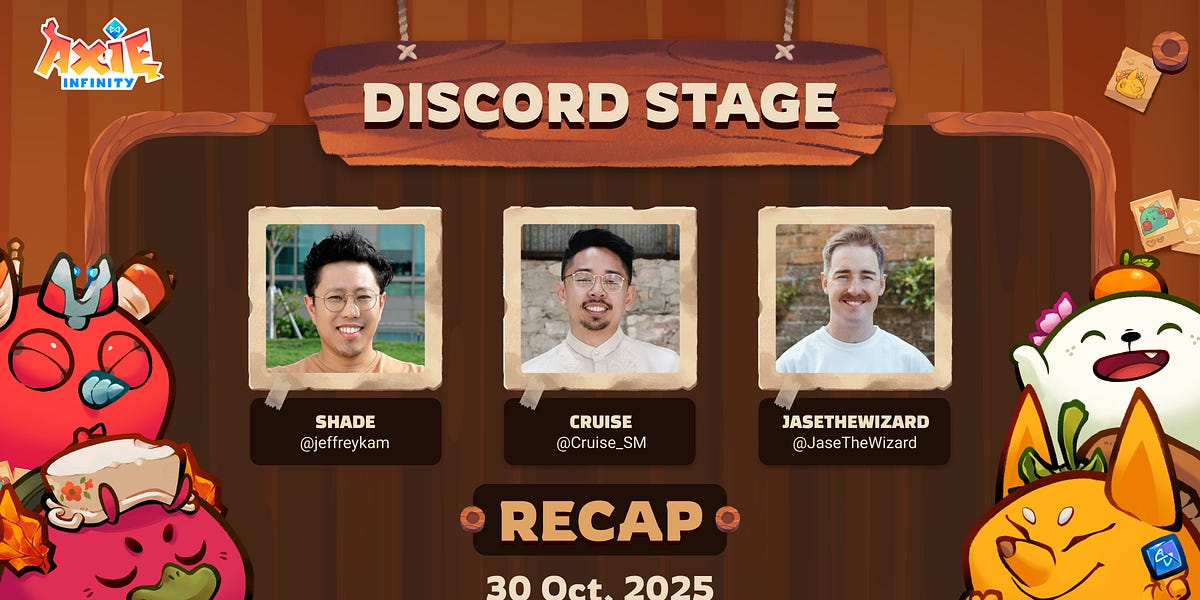
Earlier this week, the Atia’s Legacy team hosted an AMA on the Axie Discord. They discussed feedback from Playtest 1, next steps toward Playtest 2, and what they’re focused on building. Below is a summary of that AMA:
Cruise began the AMA by asking whether the first playtest answered the question.
“Can this be fun without economics?”
According to player feedback, the answer is yes. From visuals to maintenance, the team is thrilled with these results. Here’s what we found:
First, the art style became popular. Players resonated with Atia’s Legacy’s warm, mobile-friendly art direction. Testers said they could “show this to their kids” or “convince their friends to give it a try”, sparking immediate appeal beyond the Web3-based crowd.
Second, the mobile-first elements worked better than expected. ****PC MMOs dominate the genre, but rarely do teams attempt mobile-first design for deep systems. It was a test for our team. Can complex, persistent games run gracefully on small screens? This opened the door to reaching an audience far beyond the current Axie player base.
Third, gameplay retention was strong. ****Even without tokens or an on-chain loop, players kept coming back. Many people logged multiple hours each day during the testing period. “I was worried that people would play for 40 seconds and then stop playing,” Cruz said. “Instead they stayed for hours.”
This simple data point told the team that the fundamentals of combat, progression, and atmosphere were strong enough to remain fun on their own.
Players also demanded more space for depth. They wanted more ways to express their skills, mastery, and individuality. The most common feedback centered around:
-
Allows for more interactive, timing-based combat.
-
Expanded progression and crafting systems.
-
Meet Trip, a mysterious character from around the world loved by fans.
Our next playtest will validate the final game. Cruz explains it this way:
“A 1,000-hour gameplay loop — it’s still fun the second time around, as well as the 200th hour.”
The goal is to answer key MMO questions early. What happens when a player reaches the top?
The team wants to build backwards from the end game, rather than starting with an early level of content. This approach avoids the trap many MMOs fall into. The idea is to build a long grind that collapses once the player reaches the level cap.
The key points of Playtest 2 are as follows.
-
Sustainability: Ensure there is purpose and reward in the long-term gameplay loop
-
Risk and Emotion: Added stakes to make winning count
-
Community Collaboration: Verification of guild, PvP, and cooperation systems before world expansion
-
Control range: Focus on small, testable areas rather than large, empty maps
“We don’t want to disappear for a year and come back as a full-blown MMO,” Cruise explained. “We want to quickly validate big ideas with the help of the community.”
The main theme of Playtest 2 is introducing meaningful risk. This isn’t about speculation or yield farming, it’s about the real stakes inside the gameplay.
The team envisions scenarios where players bet on real things like items, materials, and even Axie’s status in competitive or cooperative battles. This is an idea rooted at the core of blockchain gaming. With true ownership comes real risk.
“If you don’t have anything, your excitement is limited to a 5 out of 10,” Cruz said. “When Axie gets knocked out in battle or her equipment gets damaged, the tension gets cranked up to 10.”
The design philosophy is ‘technology for earning.’ Think of outcomes in terms of capabilities, not spreadsheets.
Atia’s Legacy includes guardrails such as insurance and recovery systems to allow players to choose their own comfort level. Those who crave adrenaline may push for an all-in, while others may play safer but slower.
This approach is not new. games like eve online and Runescape wilderness I did it. However, Web3 ownership gives it real significance. Losing gear means it’s gone, and winning means winning something real.
If Playtest 1 is about ‘how it feels to fight’, Playtest 2 is about why you fight and who you fight. The team’s long-term vision takes great inspiration from: eve onlineLegendary player-led warfare.
Shades Detailed:
“In EVE, corporations fight over resources and destroy ships worth thousands of dollars. Social warfare on this scale is something we want to convey, but through the world and IP of Axie.”
A guild will be more than a social group. Guilds will drive the economy itself. Warriors, craftsmen, miners, and merchants all contribute differently, but their efforts are linked to a common goal: collective power and prestige.
This means:
-
Coordinated Resource Gathering
-
Guild raids and territory battles with real risks and rewards
-
Opportunity for: non-combatant To contribute meaningfully
Cruz explained:
“You may not be the one wielding the sword. You may be the one making the sword, or you may be the one fishing for the materials that finance it. Either way, you are part of the same story.”
The team calls this the social warfare layer. It is a living ecosystem that connects competition, cooperation, and economic play in one loop.
The main topics of the AMA are: interconnection.
Atia’s Legacy is not an isolated MMO. Nodes in the wider Axie network.
Axie Core, App.Axie, Legacy are being designed as follows: Complementary Experiences Share assets, players and economic logic.
Shade summarized it this way:
“In EVE Online, all classes exist in one game client. With Axie, blockchain allows these classes to spread to other worlds, all providing the same economy.”
-
Players can collect or craft them through various Axie experiences, breed or release them in App.Axie, and then use or trade those resources in Atia’s Legacy.
-
Even players who are not involved in combat at all can help strengthen their guild and economy.
-
This unified system feels like this: The entire Axie world is one living MMO
Burn mechanics are often controversial in Web3 games, but Atia’s Legacy aims to feel natural and exciting.
For example, if a player dies in high-risk content, some of their equipment or materials may be destroyed or claimed by someone else. This organic burning helps regulate supply and balance the in-game economy without arbitrary sinks.
“When risk meets emotion, players organically burn more items and tokens than a forced system could achieve,” Cruise explained.
MMO frameworks also enable horizontal complexity through more roles and interdependencies.
For example, to craft a high tier weapon you may need:
No one player can do everything, so trading and cooperation become necessary, which fuels the player-to-player market.
This tiered economic design allows for advanced risk players and and Casual crafters essential to each other. This is an important step towards long-term sustainability.
One of Playtest 2’s biggest upgrades is its party-based combat. Instead of fighting alone, players can form squads of three to five people, each with a unique role such as tank, DPS, support, or hybrid.
Our team is already testing many variations to ensure it’s visually clean, strategically deep, and rewarding whether you play solo or co-op.
They are looking at:
-
Hitbox and movement speed for dynamic play
-
Camera angles for visibility in crowded battles
-
Skill cooldown and synergy system that makes teamwork meaningful
The goal is to keep combat fun, readable, and skillful. It’s not just another flashy auto battle.
Playtest 1 linked abilities to weapons, but some players missed the sense of identity by owning Axies with unique body parts.
Cruise acknowledged this and explained future readjustments.
“We’re looking for that sweet spot where parts, equipment and grades are all important and complement each other.”
This is an ongoing process of adjustment, not a one-time fix.
Over time, owning a rare Axie will again feel both aesthetic and strategic.
Land remains one of Axie’s most interesting long-term pillars, and the team reiterated that they haven’t forgotten about it. Playtests 2 and 3 do not include lands, but experiments are already underway at App.Axie exploring ideas such as:
-
Player-created dungeons associated with land parcels
-
Territory system where guilds compete for dominance
-
A shared resource economy where the land produces the materials used in Atia’s Legacy.
Shade simply framed it.
“We’d rather validate the land through small experiments first than bake it into legacy before we know it’s interesting.”
Once it arrives, the land will become an integral part of Axie’s global ecosystem. A home for adventurers and architects alike.
Accessibility was another popular topic.
-
position: Playtest 2 is not exclusive to Mystic. More players and NFT collections will be invited to ensure broader testing data and community diversity.
-
Mobile first: The game is designed for phones first and foremost, not a scaled-down PC port. This ensures seamless play across regions with different hardware access.
-
PC options: Internal Mac and PC builds exist. A public PC version may be released if demand warrants it, but the core focus will remain on mobile usability.
-
Controller Support: Official controller integration will occur at a later date once gameplay has stabilized.
-
Performance settings: Options like adjusting resolution and optimizing frame rates are being explored to help reduce phone overheating (joke during AMA)
The team is currently targeting: Mid to late 1st quarter 2026 For the next playtest. Unlike the first build, Playtest 2 does not start from scratch, but builds on a proven foundation with a focus on validating the end game, guild system, and risk loop.
Cruise released a small teaser before closing the deal.
“We’re incorporating the next big boss into Playtest 2. It’s not just another Duke. It’s going to hurt.”
As always, the AMA concluded with a quick round of questions from the community, covering everything from gameplay balance to accessibility. Here’s a detailed breakdown of what the team shared:
Yes, but it will be rolled out gradually.
In Playtest 1, combat power came primarily from weapons rather than Axie body parts. This made some players feel that their unique Axies were less special. The team heard that loud and clear.
Cruise explained that Playtest 2 will continue to focus on validating the final game rather than adding dozens of new abilities, but the long-term vision is clear.
-
Parts and classes matter
-
Balance tuning between liver parts, gearand technology will continue
-
The goal is to avoid the “only one system counts” trap seen in previous Axie titles.
yes.
Atia’s Legacy is designed to welcome both endgame raiders and casual explorers. The team confirmed that lighter “lifestyle” activities such as fishing, crafting, farming, and homesteading will exist alongside the hardcore combat.
Even if you don’t enter a dangerous dungeon, things you craft or collect still count towards the same economy. For example, a fisherman’s catch, a farmer’s crops, and a crafter’s materials can directly support your guild’s next war.
🌟 Join the Axie Discord
🌊 apply
🗞️ Axie Media Kit